


$226,000
Diamond Bay Garden
Koh Pich (Tonle Bassac), Phnom Penh, Phnom Penh
- Est. gross yield
- 6%
- Est. net yield
- 4%
- Completion
- Completed (2025)
- Sizes
- 60m2 - 217m2
Phnom Penh & Cambodia real estate · on the numbers
Rents, yields, 1,165 private listings and 260 auctions — 1,813 properties, one desk. Here is why Cambodia, straight up.
PP residential index
2019=100
rebased
Tap for the full market read →
New developments
$226,000
Koh Pich (Tonle Bassac), Phnom Penh, Phnom Penh


$98,000
BKK1, Phnom Penh


$143,000
BKK1, Phnom Penh


$107,000
BKK1, Phnom Penh
Why invest in
The population is approximately 17 million, and 60 percent of it is under the age of 30. Education is widely accessible.
GDP grows at roughly 7 percent a year, which places Cambodia 14th in the world for growth rate.
A dual currency system. The US dollar circulates freely alongside the riel.
The largest sources of foreign investment are China, the United States, Canada, the United Kingdom, and Japan.
Cambodia is not a CRS participating jurisdiction, so it does not automatically exchange financial account information with other countries.
Resale and leasing


$550/month
1 bed85m²Apartment
Chamkarmon, Toul Tompong, Phnom Penh
Chamkarmon median · $650


$500/month
1 bedApartment
Boeng Keng Kang, BKK 1, Phnom Penh
Boeng Keng Kang median · $1,000


$600/month
1 bed79m²Apartment
Boeng Keng Kang, BKK 3, Phnom Penh
Boeng Keng Kang median · $1,000


$800/month
1 bed50m²Apartment
Boeng Keng Kang, BKK 1, Phnom Penh
Boeng Keng Kang median · $1,000


$800/month
1 bed90m²Apartment
Chamkarmon, Tonle Bassac, Phnom Penh
Chamkarmon median · $650


$142,900
1 bed73m²Apartment
Boeng Keng Kang, BKK 1, Phnom Penh
Boeng Keng Kang median · $2,500
Our approach
We start with what your capital is meant to do. Income today. Growth over time. A foundation for family wealth. We weigh that against your budget, timeline, and risk appetite. The strategy follows the goal.
We present opportunities matched to your strategy, each one backed by full due diligence and market research. Net yield, hold period, exit assumptions. You decide with the complete picture in front of you.
We handle the transaction and stay involved long after handover. Tenant placement, building oversight, exit timing when the market is right. Real estate as a system for building wealth, not a single transaction.

Market intelligence
A short letter from Samuel Doe, four times a year. What is moving in the Cambodian market, what we are seeing in our own pipeline, and what we are turning down and why. Written for investors, not for buyers. No listings, no promotions, no filler.
7 min read
Off-Plan Intelligence
 Theavy Chea
7 min read
Cambodia Market Intelligence
Theavy Chea
6 min read
Emerging Markets Desk
 Samuel Doe

5 min read
Off-Plan Intelligence
Samuel Doe

Most advisors in Cambodia's property market start with what they have to place. I start with what the investor needs to achieve. That is the standard behind every client relationship at My First Corner, where I lead the advisory practice as Managing Director. If a property does not fit your goal, I will tell you so, including when it sits in our own portfolio.
I entered this market at CBRE in 2015 and spent eleven years moving through IPS Cambodia, Century 21, and Realestate.com.kh before joining My First Corner. Every market tier, every investor type, every cycle. At CBRE I took on the rental mandate for a building the developer had struggled to lease and placed over 200 units in the first three months. That depth is not biography. It is what you are paying for when I tell you which development has investment-grade fundamentals and which is hiding a number inside the gross figure.
I did not study real estate. I studied finance: a Bachelor's in Finance and Banking, then two master's degrees in entrepreneurship, one from Royal University of Cambodia and one from Université Lumière Lyon 2 in France. I read a development the way a fund manager reads an asset class: gross versus net yield, exit liquidity, capital preservation. And I invest personally in the same market I advise on. Every property I recommend to a client, I would own myself. If I would not put my own capital there, I will not ask yours.
Before I ask about budget, location, or timeline, I ask what you are trying to achieve. The recommendation works backward from your answer, not forward from available inventory. My first off-plan placement at PS Crystal was four units for a single investor others had written off. Six units and six referred clients later, I still manage several of those properties today. Work that started as a transaction became a decade-long relationship. That is what advisory looks like when the client's goal comes first.

Where we work
Cambodia is not one market. Each city has a different investor profile, a different yield curve, and a different hold period. We work in the four below because we understand the math in each. Click through for our current view.
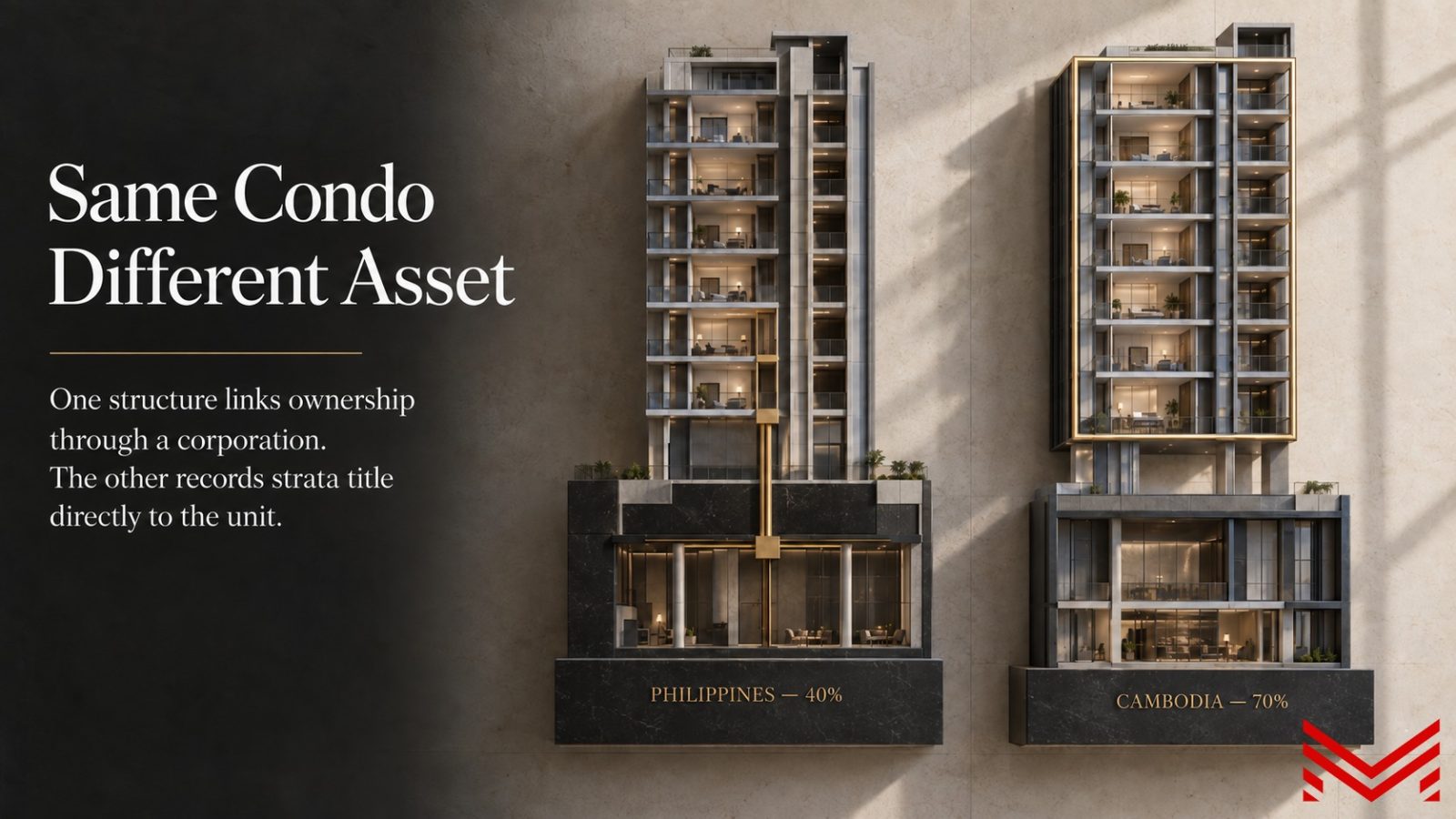
Foreign buyers can own condominium units above the ground floor outright under strata title, up to 70 percent of a single building. Land itself cannot be held directly by a foreign national; buyers use long leases, Cambodian-majority landholding companies, or strata structures instead. Each route has different costs and protections.
Our current rental book runs from roughly $350 for a studio to $9,000 per month for large serviced residences. BKK1, the central expat district, typically prices between $650 and $2,500 per month for one to three bedrooms, with serviced buildings at the top of the range.
All fourteen khans. Most of our live inventory sits in Boeng Keng Kang, Chamkarmon, Doun Penh, Toul Kouk, and Chroy Changvar, and we publish a dedicated guide for every district covering parks, dining, shopping, and daily life.
Yes. A dedicated coastal desk covers Koh Rong, Koh Rong Sanloem, and Morakot Island (Koh Puos), plus the Sihanoukville, Kampot, and Kep coastline. Beachfront mandates include verified title positions and survey status before anything is presented.
Leave your details and our desk will help you with this property, or create an account to keep your shortlist on every device.
Thank you. Our desk will be in touch. Your shortlist is saved on this device — view it.


