
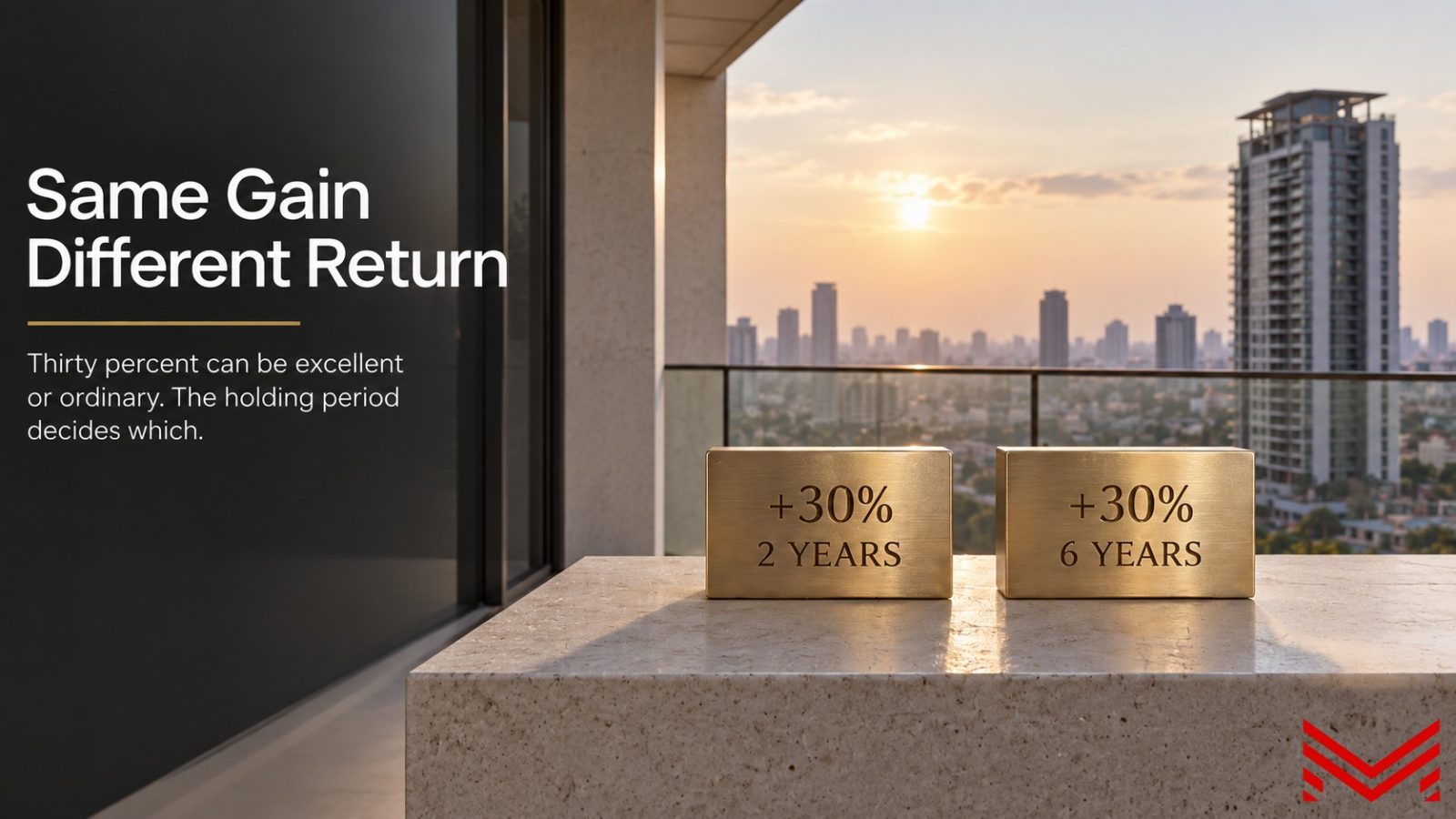
A unit bought for $200,000 that later resells for $260,000 has returned 30 percent. Whether that gain lands in two years or in six changes nothing about the headline figure and almost everything about the investment. On a time-adjusted return basis, the first case compounds at roughly 14 percent a year. The second compounds at under 5 percent, close to what a fixed deposit pays for none of the work and none of the risk.
Most property is still sold on the headline figure. The percentage gets quoted. The years it took to earn get left in a footnote, if they appear at all. That omission is not a rounding error. It is the difference between a good asset and an idle one wearing a good asset's number.
The denominator most investors leave out
A return is a fraction. The gain sits on top. Time sits underneath. Change the denominator and the entire value of the fraction moves, even when the number on top stays fixed. This is the first discipline of pricing an asset properly, and it is the one most often skipped.
The quick way to feel it is the rule of 72. Divide 72 by an annual rate and the result is roughly the years it takes money to double. Capital compounding at 12 percent doubles in six years. At 4 percent it takes eighteen. Same doubling, three times the wait. An investor who cannot state a deal's annual rate is holding a number with no meaning attached to it.
A return quoted without a holding period is not a return. It is a rumor with a percentage sign.
What locked capital actually costs
Capital committed to one asset cannot work in another. That is the plain cost of time, and it runs whether or not the asset appreciates. A gain of 30 percent over six years reads like profit until it is measured against what the same capital could have earned elsewhere over the same six years with the option to move.
Illiquidity sharpens the cost. Property does not exit on demand. A sale takes months to arrange and, in a thin secondary market, sometimes longer. The days a counterparty spends confirming title, reconciling documents, and clearing finance are days the capital stays frozen at the exact moment the owner wants it free. Time spent proving ownership at exit is time the return keeps paying for.
None of this argues against holding property. It argues for holding property that pays enough per year to justify the years.
The off-plan offset, read as a time-adjusted return
Pre-construction pricing is where time is most visibly on sale, and most often misread. An off-plan unit is acquired in stages, commonly 20 to 30 percent at signing, the balance across construction, and a final portion at handover. Through that window the asset produces no rent and cannot be exited cleanly. The price advantage against a completed unit is not a discount in the retail sense. It is an offset, compensating the investor for illiquidity and for appreciation deferred until the building exists.
Read as a time-adjusted return, the offset is simply the market pricing your patience. If it is thin against a long build, the deal underpays for the wait. If it is generous, the wait is being paid for. There is also a subtlety the headline hides. Because capital goes in over time rather than all at once, the average balance at risk is lower than the purchase price suggests, which can lift the annual return on money actually deployed above what the sticker implies.
The gaps that quietly extend the clock
Brochure yields describe a building that is always occupied and never idle. Real ones are not. A void of two months a year turns an advertised 8 percent into something nearer 6.5 before management costs. Renovation removes a unit from the rent roll for the weeks it takes to finish. A new letting takes time to place. Each of these is dead time on the clock, and none of it appears in the number printed at the point of sale.
The professional habit is to underwrite the gaps before they happen. Assume the void. Cost the downtime. Price the ramp. A yield that survives those assumptions is a real one. A yield that only works fully occupied from day one is a projection wearing the clothes of a fact.
Setting your own hurdle rate
Every serious allocation starts with a private number: the annual return that would justify locking this capital for the expected hold, given what liquid alternatives pay and what this asset risks. That number is the hurdle. A deal that clears it on a time-adjusted basis is worth the years. A deal that does not is not rescued by a large absolute gain, however impressive the figure looks in isolation.
Consider two Phnom Penh positions. A capital-preservation unit in a scarcity district might run a gross yield in the 6 to 7 percent range, with most of the case resting on appreciation that arrives later. A yield-first position in a district like Toul Tompong can run 7 to 11 percent, paying the investor sooner and leaning less on a distant exit. Neither is better in the abstract. They price time differently. The first asks the owner to wait and collect at the end. The second pays along the way. The right choice depends on what the investor's own hurdle rate can afford to wait for.
This is where the disciplined investor and the hopeful one part ways. One prices the gain. The other prices the gain per year of exposure, then asks whether those years were the best available use of the money. The second question is harder, less flattering, and far more predictive of how a portfolio actually performs.
A property does not owe its owner a return. It owes a return per year, and the year is the part of the equation that never negotiates.
The investor who prices time before committing spends less of it second-guessing afterward. Work done at the underwriting stage rarely feels urgent, and it is usually the work that decides whether the hold was worth taking.
At My First Corner, the annual math comes before the headline number in every file we open. The conversation is available when it is useful.