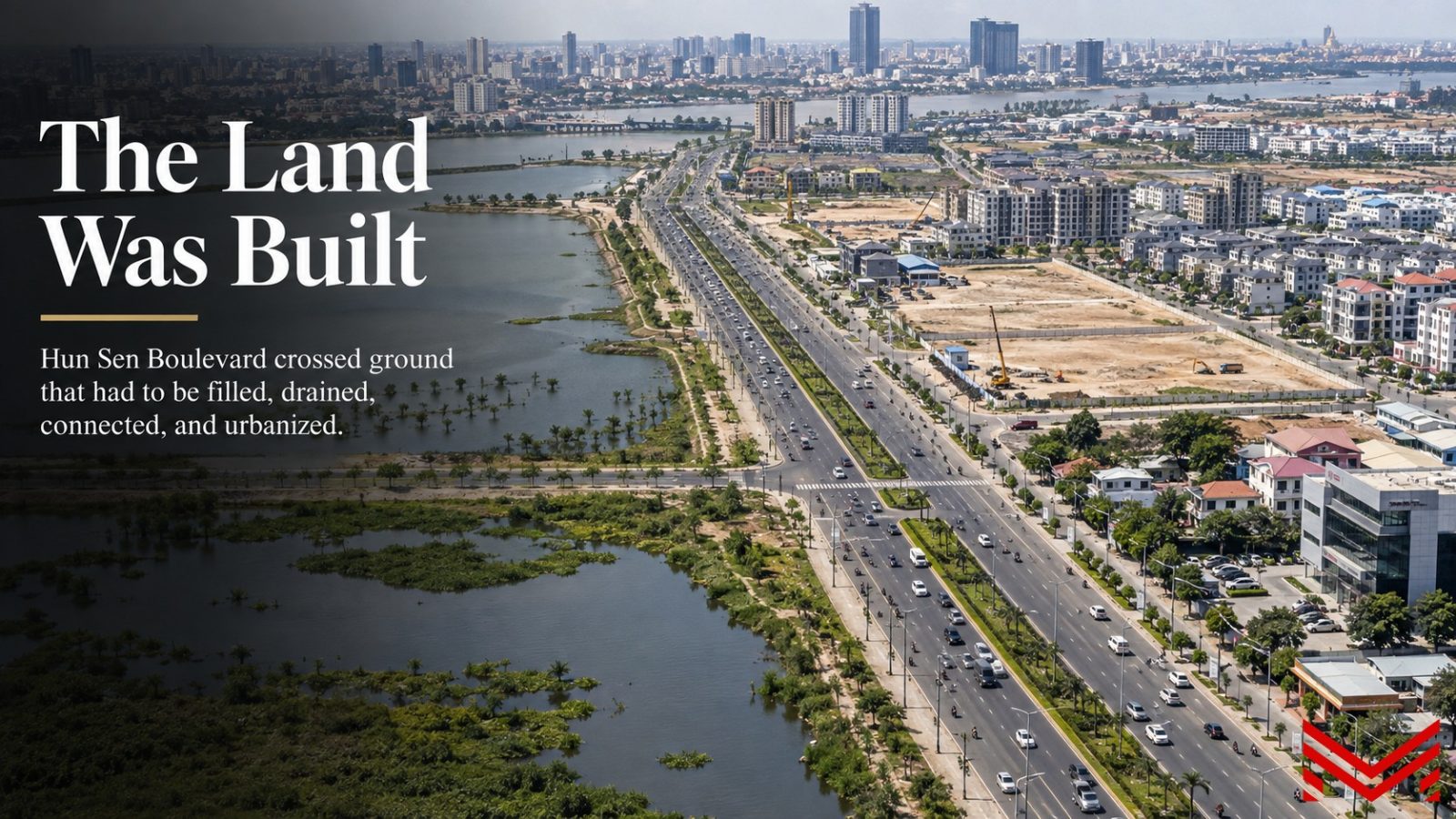
Sixty metres wide and 9,160 metres long, Samdech Techo Hun Sen Boulevard opened to traffic in April 2017 at a reported cost of about $51 million. It runs from Street 271 in Meanchey to National Road 2, and for most of that distance it crosses ground that was open water and wetland when the master plan was drawn. That single fact, more than the road's width or its name, is what an investor in ING City Phnom Penh needs to price. The land under the corridor was not discovered. It was built.
A city bought on a schedule, not a site
ING City covers 2,572 hectares across southern Phnom Penh and Takhmao, of which 1,673 hectares are zoned for residential, commercial, healthcare, education and hospitality use. The remainder is retained as water, including a 505-hectare reservoir designed into the plan for stormwater management. The master plan was started in 2007 with Surbana Jurong of Singapore, refined through a 2011 smart-city study with Japanese engineering partners, and approved by the municipality in 2014. The development horizon was set at twenty years from the outset.
Twenty years is the important number. On natural ground, an investor buys a location and waits for the city to arrive. On reclaimed ground, the investor buys a sequence: fill, consolidation, drainage, trunk road, utilities, anchor tenant, and only then the lot itself. Every step must happen, in that order, before the parcel is worth what the brochure says. None of them can be skipped, and the timing of each is visible to anyone willing to look.
On natural ground you buy a location. On reclaimed ground you buy a schedule.
That is the structural reframing this corridor requires. The usual investor question is whether the district is "up and coming." The better question is which step of the sequence has been delivered, which is under way, and what the price already assumes about the steps still pending.
What the price ladder actually records
The corridor's history is legible in its land prices, and the pattern is instructive. In the first half of 2018, a year after the boulevard opened, commercial land in Sangkat Cheung Ek at the southern end was reported around $600 per square metre, while the stretch closest to Street 271 had already moved toward $2,000 from roughly half that a year earlier. The gradient ran precisely with distance from the existing city. Where the road met established Phnom Penh, the price behaved like Phnom Penh. Where it met open ground, the price behaved like a promise.
By 2026, asking prices along the 60-metre corridor were being quoted in the $1,200 to $1,500 range per square metre, against $4,000 to $5,000 for comparable land in Boeung Keng Kang. Taken as illustrative arithmetic, a move from $600 to a $1,350 midpoint over eight years implies annual appreciation near 10 percent on asking prices, before transaction costs and before the reality that asking is not clearing. The more useful reading is the ratio. Corridor land at roughly a third of central values is the market pricing a product, not a district. Land at that level supports mid-market residential and family housing, and the observed condominium pricing along the boulevard, generally under $1,000 per square metre, confirms the arithmetic.
Two further data points belong on the ladder. The boulevard's intersection with Street 271 was widened to its full 60-metre design in early 2026 after a lengthy impact study and settlement with local residents. And the corridor now feeds directly toward Techo International Airport in Kandal, which opened in September 2025 and reoriented the capital's economic geography southward. Each is a sequence step converted into a fact, and each was priced in only after it was delivered.
What ING City Phnom Penh has already delivered
The anchors on the ground tell the same story. The International School of Phnom Penh relocated its campus into the plan at a reported cost of $40 million, leaving Norodom Boulevard for a site inside the new grid. Villa Town, a gated community of 209 residences, was completed beside it. A Mercedes-Benz dealership broke ground on the corridor. Aeon's third Cambodian mall opened on Hun Sen Boulevard in 2023 and is the largest of the three. A road matrix of 30-metre secondary streets was drawn into the master plan before a single lot was sold.
Notice the order. School, then housing, then retail, then the airport link. A satellite city built on fill cannot begin with towers, because the towers need consolidated ground, discharge capacity and a population to serve. The reservoir is not a landscaping feature. It is the hydraulic budget that determines how much impermeable surface the plan can carry. When the anchors land in the engineering order rather than the marketing order, the schedule is being respected, and that is the signal an investor should read.
Reading a reclaimed lot like an engineer
For a buyer of a strata unit along the corridor, the ground floor is excluded by law in any case, so the physical questions move upward and downward at once. Downward: how deep is the piling in the developer's cost plan, and is that cost visible in the price or absorbed in the margin. A tower on sand fill reaches bearing strata that natural ground reaches sooner, and the difference is a line item somebody pays. Upward: what is the finished floor level of the first habitable storey relative to the boulevard crown, and where does the site's stormwater discharge.
For a buyer of land, the file is longer. Which phase of the master plan does the plot sit in. What infrastructure delivery does the sale agreement actually oblige the developer to provide, and by when. How old is the fill beneath the parcel, since consolidation is a function of years, not intentions. What is the distance to the nearest completed anchor, measured in metres rather than in renderings. Whether the title is a hard title on registered land or a right within the master-plan structure, and what that difference means at resale.
None of these questions is hostile to the project. They are the questions the project's own engineers asked in 2008 when they routed a 60-metre boulevard across a lake. An investor who asks them is reading the plan the way it was written.
Where the return sits
The southern corridor is a mid-market thesis with a long tail. Land at a third of central values, a tenant base drawn from the school, the mall, the airport and Takhmao, and a road that finally connects the city's southern edge to National Road 2 without a detour through the old grid. The return is yield first and appreciation second, and the appreciation arrives in steps timed to infrastructure rather than in a smooth curve. Investors who bought the Street 271 end in 2016 caught the first step. Investors who buy the Cheung Ek end today are pricing the fourth or fifth.
The value on Hun Sen Boulevard was not found. It was poured, one load of sand and one kilometre of asphalt at a time.
Investors who read the delivery schedule before the price list tend to hold the right lot at the right phase. On manufactured ground, the distance between early and premature is the entire return.
At My First Corner, a reclaimed-land file opens with the infrastructure sequence and closes with the unit, never the reverse. The conversation is available when it is useful.