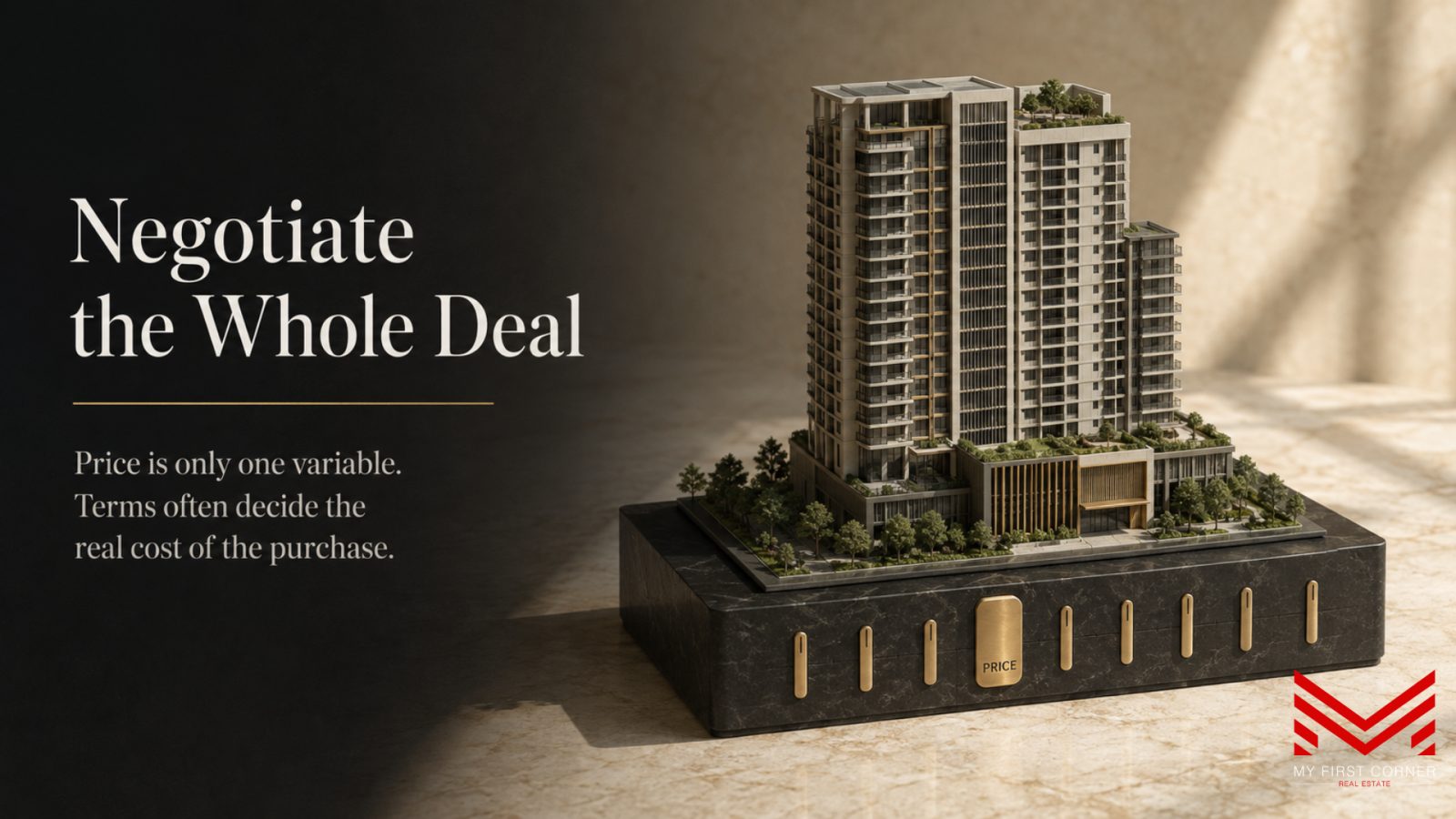
A condominium purchase in Phnom Penh carries at least eight negotiable variables. Most buyers spend all their energy on one. The headline price gets the attention, while payment schedule, handover timing, furniture, parking, maintenance fees, closing costs, and title processing sit on the table untouched. Learning to negotiate property in Cambodia begins with seeing the full table, not the single number printed at the top of it.
The market runs on preparation, not persuasion
In many mature markets a buyer can pull a public record of recent comparable sales before making an offer. Cambodia's secondary market works differently. Pricing information moves through relationships, developer price lists, and direct observation rather than a single public database. This is not a gap to complain about. It is a condition to prepare for.
The party that arrives with a documented view of what units in a specific building have actually traded for sets the reference point for the entire conversation. The party that arrives with a feeling about value negotiates from the weaker seat. A single tower can show wide unit-to-unit variance based on floor, orientation, view, and whether the unit comes furnished. Knowing that spread cold is the difference between anchoring the discussion and reacting to it.
In a market without a public price, the best-prepared party writes the price.
How to negotiate property in Cambodia without fighting on price
The instinct is to attack the asking figure directly. It is usually the least movable number in the deal, because it protects the seller's reference point for the next unit and the next buyer. The productive move is lateral.
A developer holding firm on price per square meter may still concede a furniture package worth several thousand dollars, absorb the stamp duty and transfer tax, waive the first year of maintenance fees, or extend a payment schedule that changes the buyer's real cost of capital. Each of these lowers the effective price without touching the headline the seller needs to defend. A buyer who trades across variables often ends up paying less, in real terms, than one who wins a smaller cut on the sticker and calls it a victory.
What a developer can and cannot give
Developers protect the price ladder. On off-plan inventory, the published price is a structural commitment to everyone who bought earlier and everyone buying later. Ask a developer to break it and the answer is no, for reasons that have nothing to do with the individual buyer. Understand that constraint and the conversation improves immediately.
The concessions a developer can make live in the terms, not the price line. Discounts tied to payment milestones, upgraded finishes, a guaranteed rental period, parking, and closing-cost absorption are all inside the boundary of what the counterparty is actually able to give. Early-phase buyers hold different weight than late-phase buyers, because the developer needs early velocity to fund construction and prove the project. Naming what the other side can give is half of getting it.
The secondary market rewards patience
Individual sellers behave nothing like developers. Many are foreign owners exiting a position, they price in US dollars, and they price emotionally. Here the single most useful piece of information a buyer can hold is time on market. A unit listed for six months at an unchanged figure is telling you something the seller will not say out loud.
The leverage in the secondary market sits with the buyer who is willing to wait, who holds a defined ceiling, and who can walk. Walk-away power is not a bluff. It is a genuine willingness to lose the deal, and a counterparty can feel the difference between a buyer who wants the unit and a buyer who needs it. Time on market is the seller's confession. The disciplined buyer reads it and waits.
Certainty is the concession a buyer controls
Financing for foreign buyers remains limited, and closing timelines vary from deal to deal. That environment hands the prepared buyer a real asset: certainty. A buyer who can move quickly, with clean funds and a decisive process, is worth a discount to a seller who values a closed deal over squeezing the final dollar. The professional sells that certainty deliberately, with a clear offer, a short and credible timeline, and a documented process behind it.
There is one discipline that sits underneath all of this. Verify title and complete due diligence before price becomes the subject, not after. A negotiation conducted on confirmed facts is calm. A negotiation where the buyer is still discovering what they are actually buying is not a negotiation at all. It is exposure.
Price is the loudest variable in a Cambodian property negotiation and rarely the one that decides the outcome.
The buyers who do best here treat negotiation as preparation rather than confrontation. The work of assembling comparables, reading the counterparty's real constraints, and setting a walk-away number is done quietly, before the first offer, and it rarely looks urgent while it is happening.
At My First Corner, this preparation is the file we build before a client makes an offer, not after. The conversation is available when it is useful.