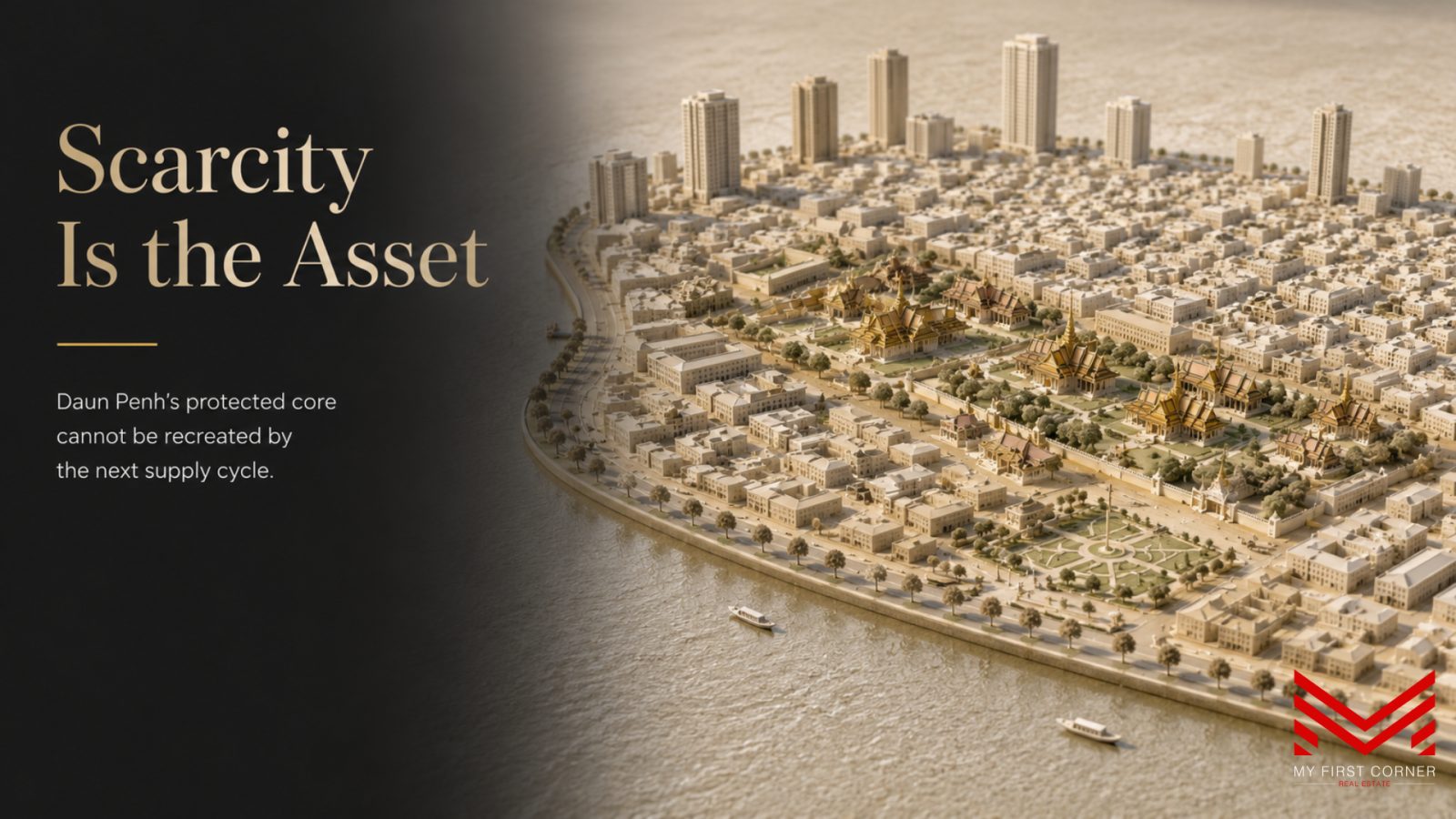
Within roughly 300 meters of the Royal Palace, new construction sits under a height line of about 14 meters. Step out to the 300-to-500 meter band and the ceiling drops further still. That single planning parameter, more than any listing photograph or marketing claim, explains why Daun Penh riverside real estate behaves the way it does. The old quarter does not trade on rental yield or on square-meter efficiency. It trades on scarcity, and here scarcity is written into the geography and the building code before a single buyer enters the room.
The Daun Penh riverside supply that cannot be rebuilt
Phnom Penh is divided into fourteen administrative districts. Daun Penh is the smallest of the central ones and the oldest, the stretch of city that sits at the confluence of the Tonle Sap and Mekong rivers and holds the Royal Palace, the National Museum, Wat Phnom, and the National Bank. The Royal Palace complex alone occupies more than 174,000 square meters of that footprint, land that will never enter the private market. Around it sits the densest concentration of French colonial fabric in the country. Of roughly 320 colonial-era buildings catalogued across the capital, Daun Penh holds the largest share of those still in good condition, structures built during the protectorate years between 1863 and 1953.
None of that inventory can be manufactured again. A developer can add floors to a tower in Sen Sok or Chroy Changvar. No one can add a second Sisowath Quay, a second palace frontage, or a second century of street grid. This is the first mechanical fact of the district. The supply is not slow to grow. In the parts that matter most, it does not grow at all.
What the height line protects
The restrictions clustered around the Royal Palace and the riverfront landmarks are frequently read as an obstacle. Read correctly, they are the asset. A skyline that stays low near the palace preserves the sightlines, the light, and the historic silhouette that give the address its meaning in the first place. Prestige in a heritage core is a function of what is kept out, not what is packed in.
The contrast is visible from the district itself. Daun Penh's own landmark tower, the 39-floor Vattanac Capital completed in 2014, rises along Monivong Boulevard, set well back from the palace core rather than on the water. The country's tallest projects, the towers pushing past 260 and 350 meters, are rising south in the Tonle Bassac area and on reclaimed ground, not in the old quarter. The height goes where the rules allow it to go. What that leaves behind, in the protected zone, is a fixed quantity of low-rise, river-facing, heritage-adjacent property that competing capital cannot dilute by building more of it.
Scarcity is a relative measurement
A scarce asset becomes scarcer when everything around it multiplies. Phnom Penh has spent the past decade adding vertical residential supply at pace, most of it in districts with room to build. Each new tower elsewhere widens the gap between the ordinary and the irreplaceable. The more the city grows outward and upward, the smaller Daun Penh's fixed core looks by comparison, and the sharper the premium on the addresses that cannot be replicated.
This is the reframing the district asks for. Most buyers price a building. They compare price per square meter, rental coverage, and handover date, and those metrics are the correct tools almost everywhere in the city. Applied to the old quarter, they miss the point. A palace-adjacent riverfront address is not priced against the tower next door. It is priced against the fact that there is no next door, and that no future supply cycle will produce one.
Every other district in Phnom Penh can grow taller. Daun Penh can mostly only grow older.
A different asset behind the same address
Treating Daun Penh as a yield play tends to disappoint, because that is not what the district is. The rental math in a heritage core rarely competes with a new-build studio cluster engineered for occupancy. What the old quarter offers instead is closer to a land position: a claim on a fixed, protected, central parcel whose value rests on permanence rather than throughput. Land positions are judged over decades, not over quarters, and they reward the buyer who understood the supply picture before the price caught up to it.
That distinction changes how the analysis should run. In a district where new supply is effectively capped, the variables that move value are the specific parcel, the specific frontage, and the specific relationship to the protected zone. Two units a hundred meters apart can sit on entirely different sides of the scarcity line. The work is not in timing the market. It is in reading the map.
The premium in Daun Penh is not a view. It is the fact that the view cannot be reissued.
Buyers who treat the old quarter as a rental instrument usually misread it, and misreading the asset class is a more expensive error than misreading the cycle. Priced correctly, this is a scarcity position, and scarcity positions are decided at entry, on the parcel, long before any exit is contemplated.
At My First Corner, scarcity is something we map before we price it, because in a district this small the difference between a sound entry and an exceptional one is usually the parcel, not the year. The conversation is available when it is useful.