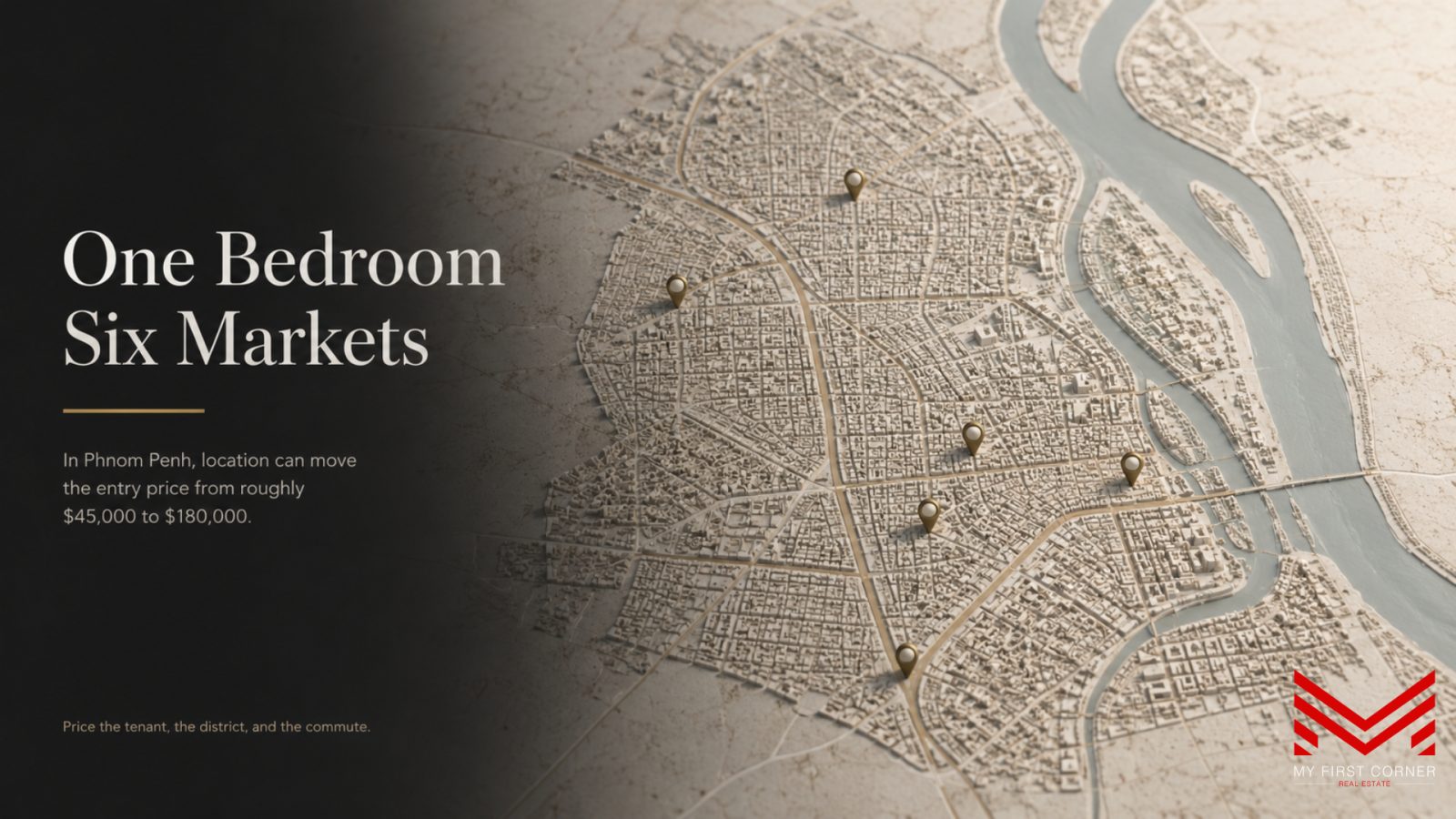
A one-bedroom apartment in Phnom Penh can be bought for as little as 45,000 dollars or as much as 180,000, and the entire difference is location. That spread, a factor of four on the same unit type, is why the real question behind "how much does a one-bedroom cost" is which neighborhood, which tenant, and how far from the center a buyer is willing to sit.
Below is what a one-bedroom actually costs across the districts investors ask about most, in early 2026. Read each on three axes: the entry price, the rental base behind it, and the quiet cost of distance. Those three, more than the sticker, decide where a budget should start.
BKK1: the top of the market
The central prime district, home to embassies, ministries, and the corporate expat base. New premium projects run 2,800 to 3,500 dollars per square meter, which puts a typical one-bedroom of 45 to 55 square meters between 130,000 and 180,000 dollars. Smaller resale units in older towers start closer to 120,000, and early pre-launch entry can dip well below completed pricing for buyers willing to wait through construction. One-bedrooms here rent for roughly 700 to 1,000 dollars a month, with furnished luxury formats reaching 1,800. The tenant pool of diplomats, development-organization staff, and multinational employees is the deepest in the city, which is what the premium buys.
BKK2: the quiet middle
More residential than its neighbor, BKK2 trades some prestige for walkability and calmer streets. Pricing generally sits between 1,600 and 2,200 dollars per square meter, placing most one-bedrooms in the 80,000 to 130,000 dollar range. It draws young professionals and long-stay expats who want proximity to the center without BKK1 pricing. Rental demand is steady rather than spectacular, which suits a landlord who values low vacancy over headline yield.
BKK3: the value entry beside the core
A buyer can cross Monivong Boulevard and be in BKK1 within minutes, yet one-bedrooms in BKK3 start from around 45,000 dollars. Much of the existing stock is local-style apartments without pools, gyms, or landscaped grounds, so the headline yield looks high while the amenity and tenant profile runs thinner. Newer projects are lifting the ceiling. For an investor, BKK3 is a calculated trade: lower entry, higher percentage yield on paper, and more work to hold the right tenant.
Russian Market (Toul Tom Poung): the district that changed most
No part of Phnom Penh has been reshaped as visibly as the streets around the Russian Market. Renovated shophouses now sit beside specialty coffee shops, coworking spaces, western restaurants, and small boutique condo projects, and the area has become the default address for younger expats, couples, and remote workers who want character over polish. Downtown is a fifteen-minute ride away, and much of daily life happens on foot.
On price, this is one of the more accessible central districts. Condos in the area start from around 1,800 dollars per square meter, and compact one-bedrooms of 40 to 55 square meters commonly trade between 48,000 and 70,000 dollars. Larger or newer boutique units, and layouts around 60 to 65 square meters, push toward 80,000 to 90,000. Most stock is sized for solo buyers and couples, which is exactly what the local rental demand asks for.
Rents tell the more interesting half of the story. A furnished one-bedroom here typically lets for 500 to 700 dollars a month, with well-finished, fully serviced units reaching 750 and simpler units available from around 400. Set against entry prices well below BKK1, that rent produces a stronger gross yield than the prime district, often by two to three percentage points. The tenant base fills quickly and stays, because in this neighborhood people commit to the streets before they commit to the building.
Toul Kork: the established residential ladder
Built around schools, hospitals, and family infrastructure, Toul Kork offers the widest price range in the city. Affordable projects start near 1,000 to 1,300 dollars per square meter, which buys a one-bedroom for 50,000 to 60,000 dollars. Mid-tier buildings run 1,500 to 1,800, premium projects reach about 2,500, and new luxury towers open from around 120,000. Rents are moderate, often 500 to 700 dollars for a one-bedroom, but demand is consistent and vacancy is low, which is the profile a first-time landlord wants.
Hun Sen Boulevard: the southern value corridor
Large new developments along this corridor have pushed entry prices down and floor plans up. New one-bedrooms can be found from roughly 50,000 to 90,000 dollars, and the value on paper is real. The number that rarely appears in the brochure is distance. A unit several kilometers from the central offices and embassies that generate dollar rent carries costs the spreadsheet tends to omit: fuel, daily commute time, and vehicle wear, all of which a prospective tenant prices in even when the buyer does not. The corridor rewards buyers who underwrite the commute, not only the purchase.
Where a budget should start
Read across the six, and the city organizes into three honest tiers.
Under 70,000 dollars, the field is BKK3, Russian Market, Toul Kork's affordable projects, and the Hun Sen corridor. This is where most first-time investors begin, and the deciding question is not price but rental base.
Between 70,000 and 130,000 dollars, BKK2, mid-tier Toul Kork, and smaller BKK1 resale units come into range. This is the broadest band and usually the best balance of entry price and tenant quality.
Above 130,000 dollars, the buyer is in prime BKK1 and new-build Toul Kork, paying for the deepest tenant pool and the shortest vacancy the market offers.
The cost of a one-bedroom in Phnom Penh is set less by the building than by the neighborhood's rental base and its distance from where dollar income is earned.
A budget is best built backward from the tenant you intend to house, not forward from the lowest price per square meter you can find. The cheapest district and the right district are seldom the same address, and the gap between them shows up in occupancy, not on the listing.
At My First Corner, we map a client's budget to the district that will actually keep the unit occupied before a single viewing is booked. The conversation is available when it is useful.