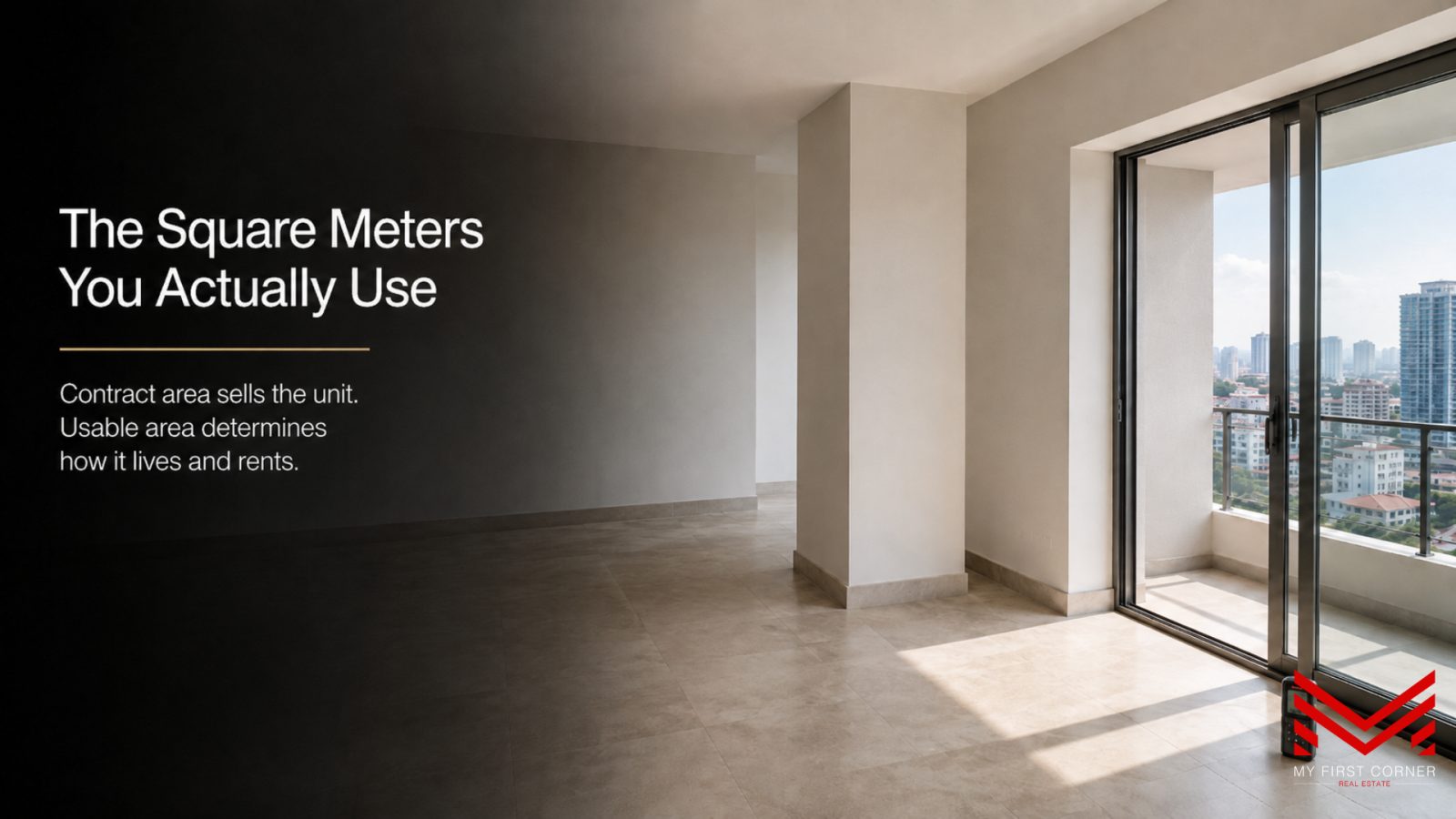
Sixty square meters is the number on the price list. Forty-nine is roughly what a tape measure returns on the same unit once the balcony, the wall thickness, and one structural column are accounted for. Both numbers are accurate. They measure different things, and only one of them is the space a tenant pays for.
Phnom Penh condo usable area is the quantity that determines how a unit lives, how it rents, and how it presents to the next buyer. It is also the only quantity in the transaction that no marketing document prints.
Three numbers describe the same unit
Every condominium unit in the city carries at least three defensible measurements.
The first is contract area, sometimes called saleable area. This is the commercial figure, and it is the denominator in every price-per-square-meter quote a buyer will see. It typically measures to the outer face of external walls, to the center line of party walls shared with the neighboring unit, and it includes the balcony, often at full value rather than at a discount.
The second is the registered private unit area. This is the surface size recorded at cadastral registration and carried on the strata title. Under Sub-Decree No. 82 of July 2010, the Cadastral Authority records on a foreign owner's certificate the proportion that the unit's surface size represents against the total surface size of all private units in the building. That makes the registered figure a legal quantity as well as a commercial one, because it feeds the 70 percent foreign ownership calculation for the entire structure.
The third is net internal area. The floor a person can stand on, measured between finished internal wall faces, with columns, service risers, and the air-conditioning ledge deducted.
Nothing improper happens between the first number and the third. There is simply no reason a commercial measurement convention and a tape measure should agree, and no market in the region requires them to.
Where the square meters go
Take the 60 square meter unit and account for it line by line.
The balcony contributes 5.5 square meters. Perimeter walls, measured to the outer face rather than the internal finish, absorb roughly 3 square meters across about 32 linear meters of wall at 150 to 200 millimeters thickness. A structural column intruding 600 by 600 millimeters removes 0.36. A shear wall segment and a service riser take another square meter between them. The air-conditioning ledge takes 0.8.
What remains is close to 49 square meters of interior floor. An efficiency ratio of 82 percent.
Now reprice it. At 2,300 dollars per contract square meter, the unit costs 138,000 dollars. Divided by contract area, that is 2,300. Divided by usable interior floor, it is 2,816. The same unit, the same money, a 22 percent difference in the only ratio that describes what the buyer will occupy. None of this argues that a balcony is worthless. In a tropical climate it earns its space. It argues that a balcony square meter and a bedroom square meter are not interchangeable units of account, and that a price list which treats them as identical has flattened a real distinction.
Price per square meter is a ratio with a contested denominator, and almost every comparison in this market is run on the denominator the seller selected.
Why Phnom Penh condo usable area moves the yield
The comfort argument is the obvious one and the least interesting.
Rent is not set by contract area. It is set by what a tenant can verify in a ten-minute viewing: how many bedrooms, whether a queen bed and a wardrobe fit in the second one, whether a dining table can sit somewhere other than the kitchen counter. Two units of identical contract area, one at 88 percent efficiency and one at 78 percent, arrive in the rental market as different products. The efficient one holds a tenant longer and renews at a firmer number.
Both were purchased on the same price-per-square-meter basis.
That is the structural point. Efficiency is presented to buyers as a lifestyle preference and settled, three years later, as a yield variable. On a unit at 750 dollars a month, a single percentage point of gross yield across a ten-year hold is worth more than the negotiation most buyers spend their energy on at signing.
The question is easier to ask before construction
For completed stock, the answer is available for the cost of a laser measure and twenty minutes.
Off-plan is where the discipline matters, because there is nothing to measure and the entire area representation lives inside the sale and purchase agreement. Three documents settle it. The stated area and how the contract defines it. The area variance clause, which sets the tolerance and what happens beyond it, whether that is a price adjustment or a right to withdraw. And the architectural plan, which is a required part of the registration file and which shows column positions, wall thicknesses, and riser locations that no floor plate diagram in a brochure will show.
A buyer who reads all three knows the efficiency ratio before the slab is poured. A buyer who reads only the first learns it at handover.
What to check before signingConfirm whether the quoted area includes the balcony, and at what percentageAsk for net internal area in writing, separately from contract areaCompare the area in the sale and purchase agreement against the figure on the strata title, and treat any divergence as a question rather than a rounding artifactOn floors above the podium, ask where the structural columns and shear walls fall inside the unit, since they migrate as the building risesRecompute price per square meter on interior floor before comparing two projects against each other
The efficiency ratio is not a hidden term. It is an unrequested one, and it is available to anyone who asks in the right sequence.
Investors negotiate the price and accept the denominator, which is the wrong way round, because the denominator is where the discount actually lives.
A unit measured properly before signing costs nothing to measure. A unit measured properly at handover costs whatever the buyer no longer has the standing to renegotiate.
At My First Corner, the efficiency ratio is calculated on every unit we put in front of a client, alongside the price. The conversation is available when it is useful.